Friday, July 6, 2012

Sonnet Love Songs by Deborah Anderson


Sonnet Love Songs 


The other day, I received a preview copy of a CD that I thought some English teachers might be interested in. Sonnet Love Songs is a brand new album from composer Deborah Anderson. She’s taken ten famous poems from authors like Shakespeare, ElizabethBarrett Browning, Tennyson, and Wordsworth and penned modern jazz compositions that highlight these great poems. The songs are peaceful and beautiful and would work wonderfully in the classroom.

For students that are much more familiar with music than they are with Shakespeare or the other poets included on this disc, the music will serve as a great entry point to beauty of these words.

This CD is a great opportunity to demonstrate an example of creative projects that can be done with poetry and would work well with books like Alan Sitomer’s Hip Hop Poetry and the Classics in the Classroom  or the poetry of Tupac Shakur .

The CD is now available on Amazon and is a perfect way to get your students interested in poetry.

Wednesday, June 27, 2012

Monday, June 25, 2012

Beowulf Performed in the Original Old English

Although the original Old English is a bit much for most students to handle, Benjamin Bagby's lively performance of Beowulf  is a great way to show your students how the story was originally intended to be heard. Check out a clip from the show here.


Wednesday, June 20, 2012

Original Shakespeare theatre discovered

According to RT.com:


The 17th century stage that saw Shakespeare’s Romeo and Juliet staged for the first time has been rediscovered in the Shoreditch district of London. Archaeologists claim they’ve found the remains of the long lost Curtain theatre.

The theatre opened in 1577 and stood until it was dismantled in the 17th century, and its remains were discovered in one of the most densely built up city areas, The Guardian reports.

Archaeologists discovered fragments of the theatre’s exterior wall. Now the experts are waiting till the site is cleared for further work. They believe that many interesting discoveries might await them as they continue digging.

The Curtain theatre was the premiere venue from William Shakespeare’s team before the Globe was built on the banks of the Thames. It stood just next to London's first playhouse, The Theatre. They are the oldest examples of purpose-built theatres in London. The Curtain received its name after the road it was facing and stood until the late 1620s.

The Globe was complete in 1599. For at least two years prior to that Shakespeare was using the Curtain as the main stage. Such plays as Henry V and Romeo and Juliet saw their premieres in the Curtain.

After Shakespeare’s team moved to the Globe, the building fell into decay and was then lost.

The site where the theatre remains were found is currently being developed. Having learned of the discovery the Plough Yard Developments plans to incorporate the remains as public open space within a mixed office, retail and residential quarter. The company now awaits further planning permission.

Wednesday, June 6, 2012

Social Networks and Summer Reading

by Matt Roberts

The advent of summer heralds the coming of summer reading. English teachers can surely get to those books they haven’t had a chance to read during the school year, and they’ve likely given their students a reading assignment to tide them over until the fall. My fondest summer reading assignment was from the summer preceding seventh grade; I had to report on The Hobbit. I’m looking forward to the movie based on the book to come out this December, of course, but sincerely hope the film won’t fundamentally alter the treasured images I had conjured up in my mind as I enjoyed Tolkien’s mellifluous prose that summer.

The New York Times’ “Learning Network” education blog has sparked a Twitter campaign to discuss summer reading. Whether you’re picking up timeless classics like Brontë’s Jane Eyre (I vividly recall the illustrations from the 1943 edition I pulled off my parents’ shelf for summer reading) or enjoying a recent book like Fforde’s The Eyre Affair, join in the conversation by using the Twitter hashtag #summerreading tomorrow, June 7th. For more details, along with classic essays and articles on summer reading from the Times, see their post here.

In other news, Ray Bradbury, author of perennial classroom classic Fahrenheit 451, has passed away at the age of 91. We at Prestwick House express our condolences to his family and friends. Bradbury was a shining beacon in the literary world, and will be sorely missed.

Wednesday, May 23, 2012

Great Gatsby Trailer

Released today, the trailer for Baz Luhrmann's adaptation of F. Scott Fitzgerald's The Great Gatsby promises a cinematic adventure like no other. Look for it in theaters in December 2012. 


"From the uniquely imaginative mind of writer/producer/director Baz Luhrmann comes the new big screen adaptation of F. Scott Fitzgerald's novel, The Great Gatsby. The filmmaker will create his own distinctive visual interpretation of the classic story, bringing the period to life in a way that has never been seen before, in a film starring Leonardo DiCaprio in the title role. "The Great Gatsby" follows Fitzgerald-like, would-be writer Nick Carraway as he leaves the Midwest and comes to New York City in the spring of 1922, an era of loosening morals, glittering jazz and bootleg kings. Chasing his own American Dream, Nick lands next door to a mysterious, party-giving millionaire, Jay Gatsby, and across the bay from his cousin, Daisy, and her philandering, blue-blooded husband, Tom Buchanan. It is thus that Nick is drawn into the captivating world of the super-rich, their illusions, loves and deceits. As Nick bears witness, within and without the world he inhabits, he pens a tale of impossible love, incorruptible dreams and high-octane tragedy, and holds a mirror to our own modern times and struggles."

Monday, May 21, 2012

Learn About the Benefits of Direct Vocabulary Instruction with This FREE Downloadable!


As funds for education fluctuate, teachers like you are forced to be discriminating in purchasing of classroom programs and supplemental materials. With this valuable downloadable, you will discover the benefits of direct vocabulary instruction as a whole, as well as the effectiveness of the Prestwick House Vocabulary Power Plus series. 

Click the button below and fill out a brief form, and we'll email you a link to instantly download your free copy of "A Research-Based Evaluation of the Effectiveness of the Prestwick House Vocabulary Power Plus Series," containing information on: 

  • The Effectiveness of Direct Vocabulary Instruction
  • Demonstrated Effectiveness of Methods in Vocabulary Power Plus for the New SAT 
  • Demonstrated Effectiveness of Online Learning 
  • Common Core State Standards Correlations for the Vocabulary Power Plus Series 
  • And More... 


Monday, April 23, 2012

Book People Unite for an Awesome Cause


Reading is Fundamental (RIF) has created a PSA aimed at reading lovers everywhere — urging us to come together to help us get books into the hands of kids who need them the most.

Remember visiting Narnia, playing Jumanji, and eating Green Eggs and Ham? Books can have an incredible effect on children’s lives, yet there’s only one book for every 300 kids living in underserved communities in the U.S.

If you could, please take a few moments to take the Book People pledge declaring your belief in the transformative power of books – and get a free download of the new RIF song. Join RIF in igniting a movement to spark a love of reading in America – and get books to kids who need them most.

Thursday, April 19, 2012

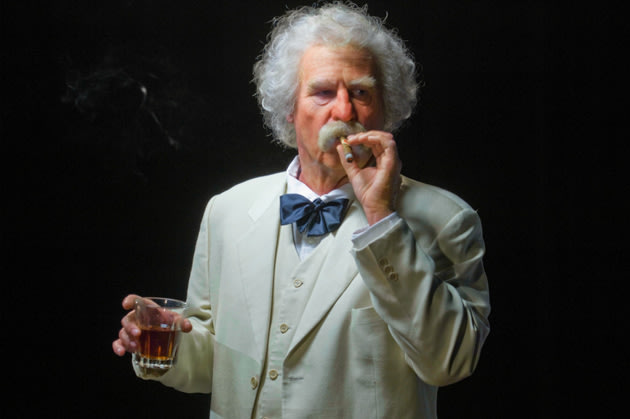
Val Kilmer unrecognizable as Mark Twain

According to Yahoo.com:


He's played the rock god Jim Morrison, Moses, and even Batman, but now Val Kilmer is taking on the diety of authors: Mark Twain, in a one-man play, "Citizen Twain," which he created. The 52-year-old wrote, directed, and stars in the project.

From the photo of him in full Twain getup, it may be hard to believe that the actor is the usually blond, baby-faced Kilmer.

The show, which will run for two weekends at the Hollywood Forever Cemetery, is all just preparation for a movie that Kilmer is set to do also as Twain, "Mark Twain and Mary Baker Eddy." The two were historical adversaries: Twain, a social satirist, and Eddy, the founder of Christian science.

The pair never met, but Twain was obsessed with her views, and wrote screeds against her. Kilmer told the Huffington Post that after seven years studying the two, "It's very much like 'Amadeus.' It's a dual biography. I'm regretting that now, because it's really hard to do."

As Twain, the "Heat" actor is unrecognizable. Fans may be reminded that the actor's trademark is exhaustive research in a role, and the Twain project is no exception. Kilmer wears the signature wild white hair and trademark mustache. His face is wrinkled, and he speaks with Twain's twang. The "Willow" actor, whose career has long been in a slump, is apparently financing the film himself. A note on the movie's website says the actor sold his New Mexico home to help with funding.

Kilmer, who is also an accomplished stage actor, told the Hollywood Reporter that the live performance is a great way into the character, who, he said, he's always loved for "his humor and genius." He added, "There's really no way of creating the role of Mark Twain without being onstage. He was a speaker, first and foremost; he did it before he was a famous writer. It's how he became famous as a writer, and it's even how he wrote novels. He would write in the morning and then read them to his children."

Thursday, April 5, 2012

The Thing About Rubrics

by Douglas Grudzina

I’m currently working on a rubric for a 9 – 12 series of writing books designed specifically to ensure attainment of the grades 9 – 12 Common Core State Standards in writing.

The series is going to be called College and Career Readiness: Writing - Levels 9-12, and is based on Common Core State Standards.

You can expect to see Levels 10 and 11 available in our January 2013 catalogue. (There’s a good reason we’re starting in the middle of the series, but that’s another post for another day.)

Some of you might want to call what I’ve been working on the past few weeks a series of rubrics because there is a distinct rubric for each grade level with articulated increasing expectations. A top-scoring 12th-grader’s piece is a significantly more sophisticated and better-written piece than a top-scoring 9th-grader’s.

But I believe the term “rubric” denotes the entire system. It might be convenient to talk about the “9th-grade rubric” or the “12th-grade rubric,” but these “rubrics” are really only parts of the larger, comprehensive rubric that traces a student’s growth from his entry into high school to his graduation and provides language to discuss successes, challenges, and future plans. And that’s the thing about rubrics; they are much more about the quality than the score.

The thing about rubrics is that they are not about the grade.
Let’s be really, really honest with each other. Grades are so vague and relative as to be almost meaningless. We all know that, on some hypothetical, ideal level, a grade of “A” denotes “excellent” work, and an “F” denotes “poor” work, but what does that mean? What does “excellent” look like? How poor does writing have to be to be acknowledged as “poor”?

Fill in the blanks in the following sentence (you know you can): “This same essay would receive an ‘A’ in Mr./Ms.______’s class, and a ‘C’ in Mr./Ms.______’s class.”

We accept as a given that some teachers are “easy scorers,” and some are “hard scorers”; but shouldn’t all teachers at the same grade level score pretty similarly? Shouldn’t they all recognize excellent work as excellent, poor work as poor, and average work as average?

If they were all working from the same scoring instrument (fancy-talk for rubric), they would.

Consider the following descriptions:
  • Writing is fluid and articulate. Tone and style seem natural and inevitable given the topic, purpose, and audience of the piece.
  • The distinctions between the student’s ideas and those from other sources are explicit.
  • If appropriate to the topic, audience, and purpose, narrative techniques enhance the overall impact of the piece.
Let’s say the above describes the top score of a twelfth-grade essay. There might be some discussion about what constitutes “fluid and articulate” writing, but the student either draws distinctions between his own claims and the claims of his sources or he doesn’t. But the rubric clearly communicates the expectation that top writing is fluid and articulate, and the distinctions between student claims and source claims are explicit.

That’s the thing about rubrics; they’re communicative.

You can give the above excerpt to just about everyone—principal, parent, student, teacher, aide, substitute, national press … and they’d all pretty much understand what your school means by “excellent.” There are no numbers, no weird scales or formulas—just the descriptions of our expectations: writing that is articulate, a style that seems natural, and distinctions between the student’s ideas and those from other sources that are explicit.

When Janyce sits down to write her essay, she knows what she needs to do. 

When Janyce’s father reads over her work, he knows what to look for. When the principal reads all the essays to pick one to publish in the Times, she’s got criteria by which to choose a good one. The teacher and aide know what they’re looking for when they grade the paper, and the substitute has words he can use to explain Janyce’s grade to her in the teacher’s absence.

So rubrics aren’t about grades; they communicate quality.

And the thing about rubrics is that they describe not only the aspired-to top quality but the good, fair, average, mediocre, and poor as well. Janyce’s essay might not (yet) be top quality, but how not-top-quality is it? And how can we tell?

Let’s look at how a rubric might describe a less-than-excellent paper to communicate to all concerned parties where the student is succeeding and where she needs to improve. In the excellent essay, the writing was “fluid and articulate,” and the distinctions were “explicit.”

In a good-but-not-excellent essay,
  • Writing is fluid and articulate. Tone and style seem natural and inevitable ...
and
  • The distinctions … are explicit.

In an average essay,
  • Writing is competent … tone and style seem forced, contrived, or self-conscious,
and
  • The distinctions … are clearly suggested.

In a less-than-average-but-not-poor essay,
  • Tone and style are … appropriate [but] lack interest and voice,
and
  • The distinctions … are usually apparent.

And in a poor essay,
  • Tone and style [are] inconsistent,
and
  • Distinctions [are] usually apparent.

The thing about rubrics is that they focus on the quality of the work and help to keep everyone on the same page. Mr./Ms. ___, the “easy grader” can’t be more forgiving of the unclear distinctions and bump the ranking of the paper up, and Mr./Ms. ____, the “hard scorer” can’t be excessively severe and evaluate an otherwise fine paper too harshly. The teacher who “likes” Janyce and the teacher who “doesn’t like” Janyce will find themselves evaluating her work by the same criteria. Janyce’s principal will know the criteria by which she will choose an essay for publication in the paper, and Janyce’s father will know where Janyce succeeded in this essay and what aspects of her writing she still needs to improve.

It almost doesn’t matter what score (or grade) the essay actually gets. A 
well-meaning “A” from a “high scorer” and a heavy-handed “C” from a “low scorer” don’t really mean all that much anyway—not if our goal is to make Janyce a better writer, a College and Career Ready writer.

The thing about rubrics, is that they are instructional tools as much as they are evaluative tools.