Showing posts with label vocabulary. Show all posts

Thursday, April 3, 2014

Practical Ideas for Adding Root Study to Your Classroom


Students encounter new words in their vocabulary every time they read. Incorporating the study of Latin and Greek roots in the classroom will not only teach students how to decode new words when introduced, but it's also a faster method to expanding their vocabulary. Check out this article and get some real, practical advice for teachers who have incorporated Latin and Greek roots into their classrooms.


"In Essentials of Elementary Reading, Michael Graves, Susan Watts-Taffe, and Bonnie Graves estimate that students learn between 3,000 and 4,000 new words each year, with the typical student knowing some 25,000 words by the end of elementary school. If your students read for thirty minutes a day, they will be exposed to an average of one million words by year's end. How many of those words will be new and how can we help them? It is obvious that five pre-selected vocabulary words from a basal textbook doesn't make the grade. Even if a new word is taught each day, in addition to five pre-selected vocabulary words for the week, that is still fewer than 400 words a year. So, how can we maximize vocabulary acquisition? One Greek word stem can open up vocabulary acquisition for hundreds of other words found while reading."

For more ideas on how to bring the study of Latin and Greek roots into your classroom, check out our two roots-based vocabulary programs today!

and

Friday, November 8, 2013

Etymology + Google Search =

by Derek Spencer


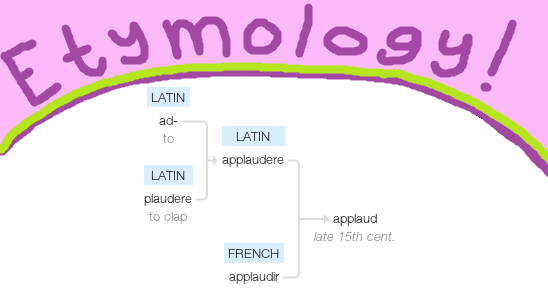
Edublogger extraordinaire Larry Ferlazzo writes that Google has added an etymology feature to its search function. It's easy to use — all you have to do is type "etymology" and then the word you're interested in, and Google will deliver an attractive chart that shows the history of the word.

It's not perfect; some words are missing, and I find myself wanting more information for some entries, but should I be expecting a full, detailed explanation in my search results? There are other resources available should I desire to dig deeper.

Overall, I think this is a nice step forward. It even shows how Latin and Greek prefixes, suffixes, and root words combine to make new words, and we think learning these Latin and Greek roots is a great way to study vocabulary.

Thanks, Google. For this one, you get a big from us!

Tuesday, September 10, 2013

Free Vocabulary Power Plus White Paper

by Derek Spencer


Want to know more about the kind of research that informed the creation of our best-selling Vocabulary Power Plus series?

Click this link to download a free white paper that discusses the benefits of direct vocabulary instruction compared against learning new words from context while reading. The latter is serviceable, but the former helps students learn more words in less time.

A sample:

Students must spend a large amount of time reading or listening in order to encounter new words often enough to understand their meanings. In “Teaching Vocabulary to Improve Reading Comprehension,” William Nagy cites a study that finds that uninstructed students have a one-in-twenty chance of incidentally learning a new word only from context (1988). Students reading a ten-page short story that contains twenty new words, therefore, will be fortunate to fully retain one vocabulary word from the text.

You'll also learn how Vocabulary Power Plus uses several instructional techniques that increase the probability your students will truly learn the words in the program — not merely use them to pass a test and forget them soon after. Finally, there's a handy Common Core State Standards alignment guide for your convenience.

If you have any questions about Vocabulary Power Plus, don't hesitate to get in touch! Give us a call Monday – Friday from 8 AM to 6 PM Eastern. Here's our number: (800) 932-4593. Hope to hear from you soon!


Derek Spencer is a Marketing Communications Associate at Prestwick House.


Thursday, August 22, 2013

5 Words that sound negative . . . but aren't

by Derek Spencer


The sound of a word can conjure all sorts of feelings. Sometimes the sound of a word evokes the emotion its meaning conveys. Other times . . . not so much.

The following words sound like they should be used only to describe terrible things. Luckily, they're not nearly as bad as they sound. Many of them have quite pleasant denotations!


Bucolic

Ugh. Just looking at this word, who could guess that it means "pastoral"? All I can think is "bubonic" and "colic." Sorry for the plague baby imagery.


Avuncular

I first came across this word while reading Rosencrantz and Guildenstern are Dead. It's a fantastic play with plenty of humor. This word, however, displeases me to say or hear. Maybe it's that second syllable that does it. The meaning's pretty straightforward: "pertaining to the quality of an uncle." Sort of strange, honestly; do uncles have inherent qualities beyond being related to a mother or father?


Pulchritudinous

My personal favorite on this list. Those first two syllables make me cringe, but the word's a synonym for "beautiful." Of course, overuse has stripped beautiful of any power it once had, so why not slot in "pulchritudinous" every once in a while?

Oh, maybe because it sounds awful. Could you imagine telling someone, "Goodness, you're looking rather pulchritudinous today"? I'd be surprised if it weren't taken as an insult.


Inchoate

My, what a lovely way to say "in the beginning stages of development" or "immature." Wait. Not lovely. Hideous. I'd rather use "incipient" or "nascent" — neither of those words sounds quite as harsh.


Crepuscular

"Resembling twilight"? Really? I would have supposed that this word meant something else altogether, perhaps something pertaining to a quality possessed by a particularly nasty wound.


What's your favorite word that sounds bad but actually isn't? We'd love to hear from you!


Derek Spencer is a Marketing Communications Associate at Prestwick House.


Thursday, August 1, 2013

Teaching Advanced Vocabulary from Literature

by Derek Spencer


Last week we asked a question on our Facebook page: what ELA content areas do teachers find most challenging to teach? Today I want to share some ideas about teaching advanced-level vocabulary with literary texts. It's my hope that we can use this as the starting point for a discussion, an exchange of ideas that will help other teachers grappling with the same task. If you want to add to the discussion, please do!

First, let's lay out some of the issues that might make teaching vocabulary with literature difficult.

1. Large word lists.

Some literary texts contain hundreds of AP- and/or SAT-level words, and reducing the number of words to a manageable list is a challenge.


Monday, July 8, 2013

5 Uncommon Definitions of Common Words

by Derek Spencer


One of the best ways to develop a robust vocabulary is to read, read, read. The more you read, the more likely it is you'll come across words you've never seen — or learn new meanings for words you already know. Here are a few common words that have an uncommon meaning when used in certain contexts. Sharing these with your students might be fun!

1. Depend (v.) — to hang or be suspended from something
Example sentence: "The locket depended from a delicate chain slung 'round the dowager's slim neck."

I was made aware of this meaning of "depend" while reading a William Gibson novel. It stuck with me.

Monday, September 21, 2009

Vocabulary: The Question is Not Whether but How

- Douglas Grudzina

Polonius, the fool, asks Hamlet, “What are you reading?” And Hamlet answers, “Words, words, words.”

True enough—we read words, hear words, speak words, write words, and—but for a few specific exceptions—we think words. Our students do too. Therefore, it behooves us (and them) to know as many words as possible so that we are better prepared to understand what others are communicating to us and better able to communicate with others.


Study after study (we’ve all read them) compares advantaged students (i.e., kids who grew up in homes with reading materials readily available and whose parents read to them when they were little) to disadvantaged students (i.e., the kids who were not read to and did not grow up in homes filled with books, magazines, and newspapers). Advantaged kids from “literacy-rich” homes start school with vocabularies that are nearly twice as large as the disadvantaged kids.


While this statistic might be distressing, it’s not surprising, and it’s not hard to understand why such a disparity exists.


What is surprising and difficult to understand is the well-documented conclusion that, once both sets of kids enter school, the gap does not narrow; it widens!


How could this be? Starting in…what?...first grade?…second?...both sets of students are handed their vocabulary books, assigned the same ten words a week, given the same weekly crossword puzzle, seek-and-find, and vocabulary test. Why, then, does one group’s vocabulary grow by as many as 3,000 words per year (an average of eight words a day), while the others’ doesn’t?


The answer—and it’s really no mystery at all—lies in how the disparity began in the first place. The parents (and other adults) of the literate students did not give their babies vocabulary books. They did not hand their toddlers weekly vocab sheets with ten words to define, name the part of speech, and list three synonyms and three antonyms. If their kids started school knowing twice as many words as their less fortunate counterparts, it was because their parents read to them.


Anecdotally, it is also surmised that these same parents paid attention to their kids when they talked and offered positive reinforcement when their kids used new and different words.


Exposing young children to words in context and words in use, then, is what explains why some kids start school knowing twice as many words as others. Might it also explain why years and years of ten-word-a-week vocabulary study serves only to widen the gap between students who are probably still being read to and talked to and those who aren’t?


Now, let’s face it, we’re not going to eliminate direct vocabulary instruction any time soon—and perhaps we shouldn’t. After all, we all know how effective simply modeling appropriate academic behavior is for the majority of our students. So, it probably is a good idea to have a systematic means of introducing our students to new words they will need to recognize, understand, and use. After all, they’re going to be learning new and increasingly difficult concepts, so they will need the language to communicate their understanding.


But, clearly, simply introducing them to the words is not sufficient. There are so many studies that show it’s not. There are no studies that indicate that vocabulary study alone is an effective way to increase kids’ working vocabularies. Just as it’s the kids whose parents read to them and spoke to them who come to school with larger vocabularies, so, too, it will be the students who actually use their new words—hear them spoken by the teacher and others, are required to speak them and write them—who will learn them.


They key is use.
Whatever vocabulary series you use, if your kids are not actually using the words they’re studying, why bother? None of us enjoys futility.

So…we’re certainly not advocating that you toss out your vocabulary program (quite the opposite since we have great faith in our programs including Vocabulary Power Plus, Vocabulary from Latin and Greek Roots, and the new Standards-Based Vocabulary Study for struggling students). But we are suggesting that you and your colleagues really examine the atmosphere—the context—in which those weekly words are defined, labeled, and played with. And make a conscious effort—make it a top priority—to get your students using the words you say you want them to learn.


After all, that’s how they learned their first 5,000 words.