Wednesday, June 12, 2013

My Argument *for* the Thesis Burger

by Rachel Carey


I will never forget the day during eighth grade when my English teacher brought a grill to class. She was going to cook us burgers, she said, but not just any kind of burgers. We’d just begun to learn the process of writing research papers that year, and she’d cemented the construct of the five-paragraph essay into our brains by likening them to burgers (triple-stacked, huge burgers).

Here’s how that worked: the two buns were the introduction (including the thesis) and conclusion paragraphs, then there were three burgers between the two buns which served as the topic sentences (or the three components of the thesis), and the condiments (lettuce, tomato and cheese between each of the patties) served as the respective three supporting sentences for each of the topic sentences —together the patties and the condiments created the greatest of body paragraphs. That was the way to perfectly craft the burger — that was the way to perfectly craft a five-paragraph essay — but she didn’t stop at the perfectly crafted.

Monday, June 10, 2013

The Great Gatsby film isn't great, but it isn't terrible either

by Derek Spencer


I saw the most recent film adaptation of The Great Gatsby not too long ago. Some critics have savaged it, but I didn't find it an affront to Fitzgerald's work. Of course, I didn't exactly love the film. I thought some elements of the movie were legitimately captivating, while others induced some serious eye-rolling.

Here's what I thought. Spoilers ahead, so take care.

Friday, June 7, 2013

The Most Useful Criticism I Ever Received

by Rachel Carey


Criticism.

The mention of the word makes all of us shiver with fear (you don’t have to deny it) as waves of low self-esteem crash and leave us breathless. Since I am a student and writer desperately trying to impress my superiors as well as keep what I know is right for me in mind, criticism is not a friend that I enjoy meeting up with often. But I wouldn’t consider it an enemy, either.

Not any more, that is.

Yes, there was a time when the mention of a meeting after class caused me to go into a cold sweat while my heart rate rose to somewhere in the realm of dangerous, but I’ve slowly learned that taking others’ opinions into account when it comes to my work isn’t so bad after all. Especially when they have what’s best for me in mind.

Below, I will recount the tale of the most useful criticism I ever received, in the hopes that it will help you help those students who are still deathly afraid of criticism come to terms with it …

Wednesday, June 5, 2013

The 5 Best (and Sometimes Hard to Pronounce) Rhetorical Devices for Winning Arguments

by Rachel Carey


Who here can say that they don’t enjoy (probably a little too much) winning an argument? It doesn’t matter what the argument is about — although I will say that one of my shining argumentative moments occurred when I successfully convinced a classmate that all of Holden Caulfield’s bad attributes are washed away at the end of Catcher in the Rye. You know the part when he tells us about how his only aspiration in life is to save all the kids that are playing in the rye field of his imagination? For me, that was a moment of, “Oh, well Holden might actually be an okay person … maybe,” after a whole novel of, “Jeeze, Holden needs to get a grip.”

Random side stories aside, it really does feel great to win an argument. Through the usage of rhetorical devices, students can learn how to (cue dramatic music) stand by their viewpoints and make rational and intellectual arguments that have the ability to sway and convince others. The following are just a few useful, fun-to-use rhetorical devices (some of which are included in Prestwick House’s Rhetorical Devices: A Handbook and Activities for Student Writers) that teachers can introduce (or reemphasize) to students when they want to put a fresh spin on persuasive writing:

Monday, June 3, 2013

Delectable Text Pairings for the Literary Palate

by Derek Spencer


French fries and ketchup; waffles and maple syrup; graham crackers, marshmallows, and chocolate: some foods just seem to be made for one another. And just as these food pairings can help reveal new flavors to the taster, so too can pairings of literary texts help your students understand “ingredients” like genre, theme, and character. Here are some text pairings that will help students learn important literary elements while adding some serious flavor to your classroom.


Friday, May 31, 2013

10 Things I Wish My High School English Teachers had Taught Me

by Rachel Carey


Hey, everyone. My name is Rachel. I was lucky enough to be given the opportunity to intern at Prestwick House this summer, so it looks like you’ll be hearing a lot from me in the next few months! Currently, I am a rising senior at University of Delaware, studying English, with a concentration in Creative Writing and Sociology. I’m twenty and, like every other person my age, trying to figure out how to get where I want to be (which is hopefully amongst award-winning authors on the New York Times Best Seller List). But I digress …

There comes a time in all of our lives — excuse me for becoming a little clichéd here — when we look back and think about how naïve we once were. Most of us wish, at one time or another, that our current selves could go back to our awkward, confused high school selves to tell him or her that our lives are going to turn out just fine, regardless of the fact that we wore the same shirt two days in a row and got called out for it by fellow classmates.

For me, in high school, because I was obsessed with everything having to do with English, reading, writing, and books (this shouldn’t surprise you), the English classroom was my haven. My English teacher was kind of like a guardian angel — he didn’t really care about my outfit, and didn’t even know that I dropped my lunch tray on another girl’s head in the cafeteria; all he cared about was that I understood the thematic importance of Chief Bromden’s character in One Flew Over The Cuckoo’s Nest and could write a paper on it.

(For all of you wondering, my argument was that the Chief stood as a silent bystander while McMurphy did all of the dirty work in the beginning (e.g., his attempts to dethrone Nurse Ratched). Chief may be silent, but he saves McMurphy’s dignity by suffocating him after his lobotomy at the novel’s end. Loss of dignity through oppression seems to be a major theme in Kesey’s novel, and the Chief saves McMurphy and himself from having to deal with Nurse Ratched’s villainous ways any longer. He’s a hero, just like McMurphy).

Anyway …

My High School English teacher taught me a lot about books and a lot about myself. But there are a few things I wish that I had learned earlier in the English classroom than I did …

1. Organization is key.
First things first, I have to confess something: I was probably one of the most organizationally challenged high schoolers ever. Sadly, it took me a while to realize that it takes more than colorful sticky notes and labeled folders to automatically become organized (I’ve adjusted since high school and have started keeping extra copies of assignments on about fifteen easily accessible “clouds” on the internet). But it’s true — if students are organized on the outside, it is easier for them to succeed in the classroom. Akin to procrastination, the need to be organized often is not fully understood until a disaster happens or something is lost. However, fostering good organizational habits when the opportunities present themselves is never a bad idea.

2. Learning is more important than grades.
This is a difficult lesson to grasp. For students, the pressure to get perfect scores often makes it hard to come to terms with the fact that the value of the literature and the lessons learned are more important than the grades that come with them. Creativity (where appropriate), understanding, and learning should go hand in hand. Every once in a while a student misses the mark, and the surprise of getting a C when they were expecting an A can be frustrating. Most of the time, however, a good understanding of material will yield good results.

3. For some, Shakespeare’s language will never be easy to understand.
My High School English Teacher constantly reassured us that Shakespeare would (eventually) get easier to understand; as if one day we’d wake up enlightened and able to read Richard III in one sitting, understanding every word. But the truth is that some students have more trouble than others (I know I did). Of course, the fact that it is difficult doesn’t mean readers should just give up. There is a reason why Shakespeare is taught in essentially every High School English classroom. For students who are finding Shakespeare especially difficult, it could be helpful to point them in the direction of a book (like Prestwick House's "Side-by-Side" editions) that has Shakespeare’s English alongside Modern English. Of course, Shakespeare’s version should be the one that is mostly focused on, since that is where the literal meaning of his language is found. But, perhaps after studying the two versions side by side, students might actually grow to love Shakespeare’s phrasing, without that moment of panicked misunderstanding.

4. Some books are meant to be read out loud.
I learned this very important lesson in one of my first college classes. We had to read the Charles Dickens’ novel, Our Mutual Friend (aka, 854 pages of dense, beautiful, terrible sentences that were very easy to get mindlessly lost in), and I couldn’t understand a single page without having to go back and reread it. My teacher insisted that reading Dickens out loud would help, and it did. Often times, the beauty and meaning of a writer’s work doesn’t fully sink in until it’s being read out loud. Now, in the perfect world, every one of Shakespeare’s plays would be acted out in the classroom, and it would be acceptable to read books and poetry out loud in public places. Of course, this is not the perfect world. However, introducing student readers to the idea of reading difficult literature out loud may be helpful in fostering a deeper understanding.

5. Procrastination should be punishable by law.
All students have heard this before. But, procrastination is a hard temptation to overcome because it taunts students with the possibility of activities that are more exciting than staring at blank space on a computer screen. Deep within their hearts, students know that one paragraph a day is a much easier road to success than fourteen paragraphs in one night. But, let’s face it, voluntarily structuring life around a paper is not enjoyable for most. Often times, assigning specific due dates to individual pieces of the project can help students learn time management and complete work with time left over. They might groan when they realize that they can’t push it off ‘til the last minute, but they’ll be thankful when they sleep for more than twenty-five minutes the night before the whole project is due.

6. Needing help is not a sign of weakness.
For many high schoolers (including the one I was), the idea of asking for help on papers and test preparation seems more daunting than it’s worth, simply because criticism is hard to welcome. But needing assistance is nothing to be ashamed of. A student’s goal should be to reach a better understanding of the material (books, literature, thematic questions that teachers probably geek out about outside of the classroom anyway), and students are more likely to achieve this goal if they allow you to help.

7. There is never one clear answer.
This is what is so cool about studying and teaching English: there are infinite ways to interpret literature, endless possible topics to write about, and there is never just one right answer for any of it. Unlike Math, where the pressure lies in answering equations successfully in order to come up with the singular end product that every other person in the universe also should have gotten, English is a subject that fosters individualism and creativity. Basically, logical arguments are all that’s needed in order to prove that a point is correct.

8. Anthology angst.
Let me be more specific: I find that I am much more likely to read assigned material if I have the story or novel in actual book form rather than in textbook form. Large anthologies can be hard to read anywhere but at a desk. In school, they work great. But for homework? Anthologies are heavy. Trying to read an anthology while lying down, holding said anthology overhead, can often result in a black eye. Urging students to use smaller versions (especially of longer selections) for take home reading might increase the number of students who read … especially if they have suffered from such anthology-related injuries as I have.

9. English Majors aren’t always unemployed.
When I tell people I’m an English Major, the disappointment and worry in their eyes is evident. They worry for me, which is nice (I guess it shows that they care), but it’s not needed. The sad truth is that modern students are put under a lot of pressure to be successful in school (this is measured by grades), as well as beyond school (this is often measured by money acquisition). Often times, this means that the road a student is passionate about is not always the road they are most likely to travel by. What I’ve learned recently is this: Success comes to those who work hard, no matter the field. Passion gives students the fuel to work hard, and there is no reason why passion cannot be the driving force behind success in the career world.

10. Dislikable characters do not automatically create a worthless book.
A lot of times, as readers, we zero in on characters — sometimes we love them, sometimes we hate them — and make them into either our imaginary best friends or absolute monsters. Either way, as I said before (see point 7), there is never a singular right interpretation. But, too often, this fictional relationship between reader and character causes us to construct an overarching opinion of the book as a whole. It is essential to remind students that the character isn’t the only influential aspect of a book — plot, thematic elements, dialogue, as well as the rest of the characters, all influence the book and make it what it is. There is a reason the author made the character dislikable. Basically, there is nothing wrong with disliking characters and their motives, but the importance of them in the novel should be taken into account before labeling the book as “not worth finishing” two chapters in.


Rachel Carey is a summer intern at Prestwick House. She is also a senior at the University of Delaware, where she studies English with a concentration in Creative Writing. During the school year, she is an active editor and writer for Caesura and The Main Street Journal, both of which are prominent literary magazines on campus, as well as Vice President of The Blue Pen Society writing club.

Friday, May 24, 2013

The Week's Best Links: May 20 - 24

by Derek Spencer


Hey there! Here's the shortlist of links we found enjoyable and useful this week. If you have any you'd like to share with your fellow teachers, let us know in the comments!

Tech:


From the Free Technology for Teachers blog, this link has a few great resources for teaching the works of Shakespeare. The TED-Ed video about Shakespearean insults is particularly amusing — and it's based on analyses of dialogues from a couple of plays, so it shows students how Shakespeare's specific words produce specific results.

http://www.freetech4teachers.com/2013/05/5-good-resources-for-teaching-learning.html#.UZ5BSZzB-So

More and more schools are adding Twitter to their teaching toolboxes. Whether you're new to Twitter or a seasoned pro, this lovely infographic might help you discover new hashtags related to education, which will then help you discover new topics, new people, and new ideas.

http://www.edtechmagazine.com/k12/article/2013/03/printable-list-best-education-hashtags-infographic

Leadership and Professional Development


According to this article, praising students for intrinsic qualities (such as intelligence) might actually decrease their motivation to learn and to improve.

http://www.brainpickings.org/index.php/2013/05/23/stephen-grosz-examined-life/

Summer's almost here, which means it's almost time to start planning for fall. Here's some advice on developing a plan to improve your school's climate — and making sure you accomplish your plan's goals:

http://blogs.edweek.org/edweek/finding_common_ground/2013/05/creating_a_plan_is_easyfollowing_through_is_hard.html


ELA in the real world:


If your students ever question the value of learning punctuation, you might want to show them this article — a Canadian company may have lost one million dollars (cue Dr. Evil pinky-to-lips gesture) thanks to ONE comma in a contract.

http://www.nytimes.com/2006/10/25/business/worldbusiness/25comma.html


Ideas and Opinions on Education


Seth Godin is a smart guy (that’s an understatement), and he has eloquently expounded upon several subjects in various fields like marketing, web design and — here — education. The link below takes you to a page where you can download a free copy of his ebook Stop Stealing Dreams in several formats. It's a sizable ebook, so it might be good for a weekend read.

http://www.squidoo.com/stop-stealing-dreams

Wednesday, May 22, 2013

Don’t Shoot (or Kiss) the Messenger

by Douglas Grudzina


I am not a luddite.

I needed to get that off my chest because when I mentioned that I was writing this post, one of my colleagues accused me of being one, and I’m not.

What I had told this colleague was that I was going to expose a troubling trend in education and technology. It’s not a new trend — I can think of how it manifested itself in the 1960s when I was in elementary school — but it is a persistent trend.

It’s not intentional; in fact, I think most of us caught up in the frenzy of innovation don’t even realize we’re doing it. Or we think we’re doing exactly what we’re supposed to be doing.

In terms of “raising the bar,” however, and bringing students in the United States up to international par in their ability to read, write, think critically, and reason, we’ve actually let ourselves become a part of the problem.

You could say we’ve put the cart before the horse.

Or we’ve thrown out the message because we’re always in search of a new and better messenger.

Imagine an English class. The eager, young teacher is about to teach A Tale of Two Cities. In this school, students provide their own copy of whatever they’re studying. On the first day of this Dickens unit, several kids come to class with paperback editions of the novel. Some of these display black covers with wallpaper-like designs. Some are flashy and new with a photograph from the most recent film version of the novel—maybe starring Leo DiCaprio in the dual roles of Charles Darnay and Sydney Carton (in 3D).

Other kids have hardcover editions. One is an ancient thing, crumbling and bound with rubber bands.

One kid found the book on Bartleby or Gutenberg and printed it out in green ink on pink paper, securing it in a three-ring binder. The rest have downloaded one e-book version or another onto their (you name the brand, make, and model) e-reader.

Somehow, this teacher is able to verify that every kid’s book is whole, complete, unabridged, unedited, unexpurgated … you get the idea.

Now imagine this teacher sending the ancient-volume-kid home because his book is “too old.” The three-ring-binder kid is penalized because hers isn’t a “real book,” and the e-reader kids are given extra credit for “originality and insight.”

What would you say?

Here’s another example: A traditional twelfth-grade assignment in the high school where I taught was the “Shakespeare Scene.” As the name suggests, the assignment was for groups of students to prepare and then perform a scene from a play by William Shakespeare. Over the years, I had a few students come to class and perform their scenes live. Most groups opted to videotape their scenes (and some of these were really very clever). A couple of groups did puppet shows. One group—toward the end of my classroom career—did a Tim Burton-style stop-motion animation.

Scoring criteria were always explained at the beginning of the project: “appropriateness” of set or location, “appropriateness” of costumes and props, overall cohesiveness of the scene, and familiarity with the script. We defined “appropriate” as fitting the action, mood, and location of the scene even if the students had to modernize because they were unable to locate an Elizabethan doublet or a Danish castle.

When the group that did the animated video received a relatively low grade (if that surprises you, keep reading), they protested. They’d spent HOURS, they said, making their construction-paper set and their little clay Macbeths and Macduffs. They’d spent ADDITIONAL HOURS clicking-and-dragging, frame-by-frame, to shoot five minutes’ worth of Macduff slicing off Macbeth’s head.

They knew they’d spent “way more time” on their scene than the clowns who had made daggers out of cardboard and aluminum foil and wrapped up in bed sheets to perform the assassination of Julius Caesar in front of the class.

Now, these guys didn’t fail; their grade was a solid B. But they did not get the A+++ they thought they deserved. They were not “copping an attitude”; they were not entitled-acting brats who believed every breath they breathed was Divine. They were seriously upset; they were hard-working kids who were not getting the grade they believed they deserved.

Can you guess why I gave the grade I gave?

Here’s a hint: They got very high scores in all the “appropriateness” and “cohesiveness” categories, but they got almost no points in the “familiarity” category. While all of the other students were getting intimate with Shakespeare’s words, the animation group was gluing their set and sculpting their clay figures. While the other students recited their lines from memory (because “familiarity with the script” was one of the scoring criteria), the animation group read theirs. They could answer only the most basic questions about who said what, to whom, and why.

Their project would undoubtedly have earned them that A+++ if they’d been in a cinematography or animation class. But for my English class, what had been the main point of the project (as suggested by the relative weight of each category) had received the least attention.

The other day, I was listening to a webinar in which a participant — a college-level English instructor who also does inservice programs for high-school and middle-school teachers — was advising us listeners to have our students do PowerPoints, write blogs, and participate in social media. She then explained how readily available PowerPoint software is, how easy it is to set up blog accounts, and how many different types of social media there are out there. What she did not explain was exactly what our students were supposed to do in those PowerPoints. What were they supposed to say in the blogs?

That’s when I decided to write this post, and my colleague called me a luddite.

He called me a luddite because I averred that, unless I am teaching (or taking) a social media or informational technology course, the delivery medium is irrelevant.

I’ll say it again from a slightly different angle: In a standards-based (or content-based) English classroom (or science classroom, or social studies classroom), the delivery medium is irrelevant.

What I wish that expert teacher (and many, many others over the years) had advised her listeners was that, in order to provide their students with authentic opportunities for personal writing for a real audience, they should try blogging. A cool part of the research process — that would allow kids to practice expressing in their own words what they’ve learned and to give appropriate credit to their sources — could be to have them put together a PowerPoint presentation. To get the kids reading and discussing their reading with others outside of class, teachers could set up classroom forums or wikis.

The point is not the medium but what we do with the medium.

Now, it’s possible that this is exactly what the expert teacher meant, and some of her listeners might have known it. But I can guarantee that there were a lot of listeners who left that webinar thinking, “I need to have my kids do PowerPoint presentations … and write blogs.”

I can guarantee these dedicated and well-intentioned teachers did not leave that webinar thinking, “My kids need to do more frequent personal writing. They need practice expressing information in their own words and crediting their sources.” They wouldn’t have thought this because the expert teacher did not say — or even suggest — this. She simply advised us to have our kids do PowerPoints, blogs, and social media.

Now, here’s why I’m not a luddite.

I’m not opposed to any particular delivery medium. When I was in high school, if we wanted visual aids, we had to draw pictures on construction paper, or Photostat them out of books and glue them onto cardboard. Then, we had to remember to insert them into the opaque projector upside-down and left-facing-right.

Many a National Geographic was sacrificed to “the classroom collage.”

A soundtrack required a steady hand to drop the needle on just the right spot on the album and then pick it up again—without making that amateurish scratch sound.

And, of course, the house had to be utterly silent while the cassette recorder was on.

So I welcome technology that allows kids to make their images appear and disappear as if by glittery magic. How wonderful it must be for them to be able to splice together an entire soundtrack in GarageBand and import it distortion free into their presentation. It’s great that they can form a Great Gatsby book club with readers in Sweden, Japan, and Canarsie.

But as the available media become more fun and the potential for flash and dazzle increases, we need to be ever aware of our tendency to turn the messenger into the message. When too much attention is paid to the shimmering words and not enough to what those words are communicating, when kids honestly believe that the hours they spend creating life-like Play-Doh figures are hours well spent on a project for English class, we shouldn’t scratch our heads and puzzle over why their scores on tests of reading comprehension and critical thinking are so low.

As English teachers, we know our kids are not going to be tested on the aesthetics and functionality of their blogs. They will, however, be tested on the knowledge that could be displayed in a blog post.

Media, as you know, is the plural of medium; and a medium is merely a “means of transmitting.” Good news is still good news, whether it arrives by telepathy, text, snail-mail, or smoke signal. And bad news is still bad.

Just don’t shoot the messenger.

Douglas Grudzina has over 25 years’ experience teaching high school English and consulting with the Delaware Department of Education on ELA curriculum and assessment. He has been a popular presenter at conferences and inservice workshops. As Senior New Product Development Specialist at Prestwick House, he has created and shepherded the Advanced Placement in English Literature and Composition, the Teaching Literature from Multiple Critical Perspectives, and the Levels of Understanding lines of downloadables and reproducibles. His books include Reading and Analyzing Nonfiction: Slant, Spin & Bias, Prestwick House AP Language and Composition, and the just-released College and Career Readiness: Writing series.

Wednesday, May 15, 2013

Choosing Texts: Do the Common Core State Standards leave room for teacher discretion?

by Magedah Shabo


No one likes the idea of forced conformity and “one size fits all” solutions. Not surprisingly, one of the chief concerns we hear from teachers about the Common Core State Standards (CCSS) is that they seem to take a cookie-cutter approach to improving education.

Indeed, the standards do represent a general push toward standardization, as their name implies. Perhaps most conspicuously, they propose a universal shift toward more difficult texts and tasks than have traditionally been assigned in recent decades. In the English Language Arts category, there is an emphasis on teaching literary and informational texts that are significantly more difficult than those currently taught in most American schools.

In the Common Core literature, this upward shift in text complexity is described in the rather arcane language of the Lexile Framework, as shown in the chart below.

Text Complexity Grade Bands and Associated Lexile Ranges
(CCSS English Language Arts Appendix A, page 8)

Looking at these charts and figures, many educators fear that the standards do not adequately account for the variation among students and classrooms. Is it really feasible to take any given twelfth-grade classroom and suddenly begin teaching what we think of as college-level texts? What about the students who are struggling with the less challenging literature they are currently being assigned?

One educator who serves on Prestwick House’s National Curriculum Advisory Board described the concerns of many when she told us, “The idea that all students can learn to the same level of understanding, while high-minded, is just not true.”

There is good news, though. Within the CCSS framework, there is still room for teachers to exercise personal discretion and choose texts that make sense for their students.

The standards do not require teachers to do any of the following:

  • Replace human judgment with Lexile scores.
  • Disregard students’ abilities and backgrounds.
  • Teach from a prescribed list.

What, then, are the standards proposing for the text-selection process?

The CCSS identify three factors to consider when gauging text complexity:

  1. qualitative measures
  2. quantitative measures
  3. reader and task considerations

These three factors are depicted in the standards’ Appendix A as three parts of a triangle—and each element is given equal weight.


It’s important to note that the quantitative element—a computer-generated number, such as a Lexile score—is only one part of the triangle. This is the only factor that is not ultimately left to the judgment of a human being, whether it be a district administrator or an individual teacher.

What’s more, the standards directly state that quantitative measures are not always accurate and should not be used to overrule the judgments of educators. Appendix A says that educators are expected to balance quantitative and qualitative considerations by “employ[ing] professional judgment to match texts to particular students and tasks” (page 7). Quantitative measures will, in fact, be outweighed by the other two-thirds of the triangle in many cases.

In upcoming posts, I’ll be talking about the strengths and limitations of the Lexile Framework and other quantitative measures, as well as their proper application. I’ll also be unpacking the more subjective factors in selecting CCSS-appropriate reading assignments—the “qualitative” and “reader and task” considerations. When it comes to choosing texts for your classroom, the Common Core standards may not be quite as limiting as they initially seem.


Magedah Shabo is the creator and co-author of Prestwick House's Reading Informational Texts series. She is a writer, editor, and community college instructor. Her works are taught in secondary and post-secondary classrooms across the United States and have been featured on reading lists for courses at Harvard, George Mason, Fordham, and American University.


Friday, May 10, 2013

The Making of the Iliad and Odyssey Book Covers

by Larry Knox
Creative Director


We recently decided to rebrand the Literary Touchstone Classics collection, our popular line of classic literature books. Although most of the over 70 titles in the collection will retain their original cover art, a few volumes warrant a fresh approach.

Sold as two separate books, Homer's The Iliad and The Odyssey were prime candidates for new cover imagery. It occurred to me that this would be a perfect opportunity to re-design each so when laid side-by-side they would form one continuous image — a technique I've always wanted to try. Essentially, the covers would represent the journey taken by Odysseus from his service in the Trojan War to his ten-year voyage home to Ithaca.

Starting off, I knew I wanted three major elements: Helen of Troy, an archer, and a Cyclops.

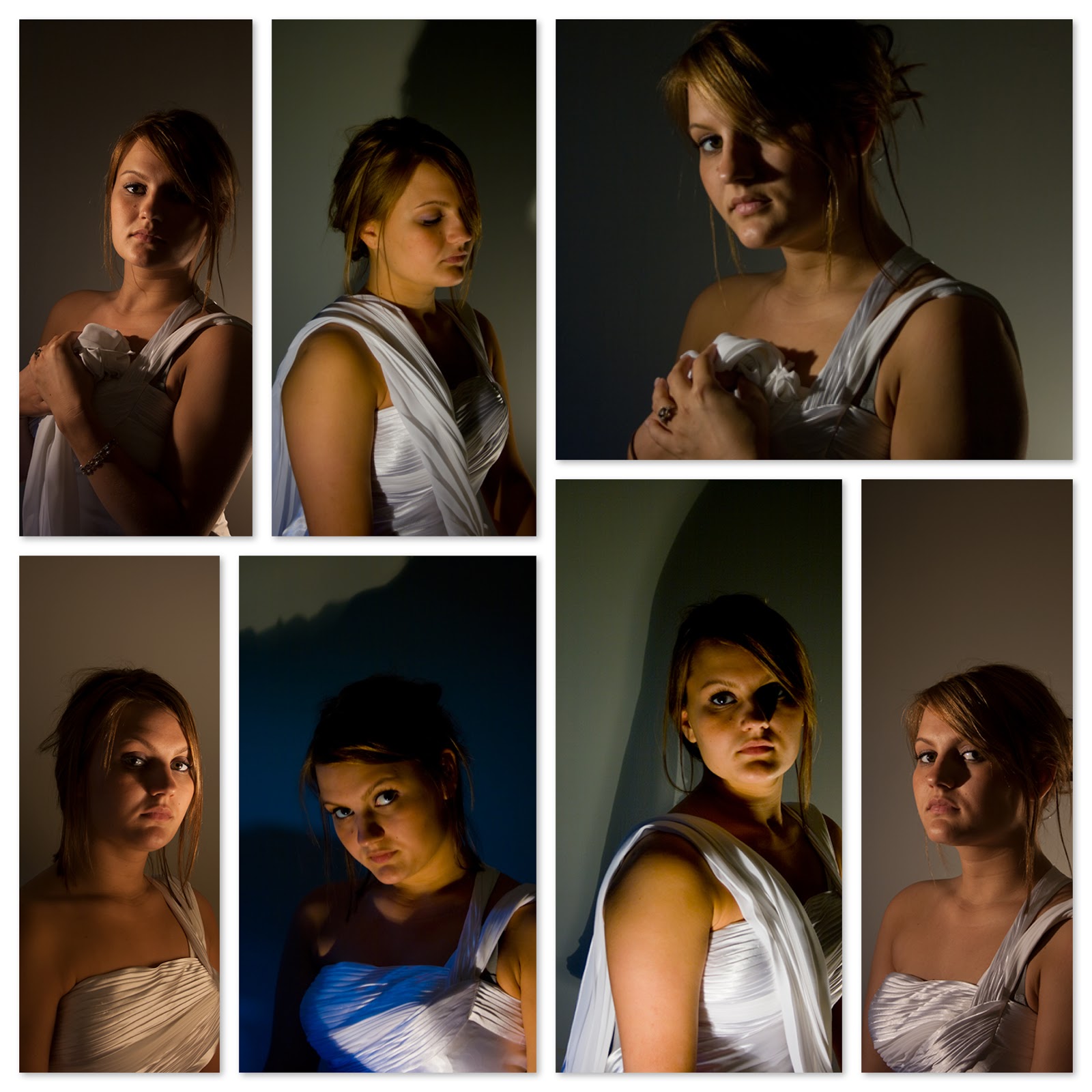
Hoping to use them on a reprint of The Iliad one day, I took photos of my niece a few years ago when she wore a Grecian-style dress to her high school formal. So, Helen was done.

Having never been pleased with the existing cover of The Odyssey,
I asked my niece to pose as Helen back in 2009.
Photo by Larry Knox  © 2013 All rights Reserved

The Greek archer on the cover of The Iliad would double as Odysseus on the The Odyssey's side — evoking the archery competition during which Odysseus outshoots and slays his wife's unwanted suitors.  I had the helmet from a previous photoshoot, but the key for this shot would be finding just the right bow and arrow for the period.

Setting up two light sources, each connected to the camera by a transmitter. I took over 75 shots using a 10-second timer, which allowed me to move the front light up or down and left or right.

Three Rivers Archery in Ashley, Indiana, was kind enough to donate the use of a Scythian bow, which is very similar to the ones used by the Greeks during the time of the Trojan War.

The arrow is wood, charred over a candle flame to get the decorative stripped effect. I tied feathers to one end of the arrow with leather string and in Photoshop placed a public domain image of a Hellenistic era arrowhead on the other.

Photo by Larry Knox  © 2013 All rights Reserved
Photo by Larry Knox © 2013 by Prestwick House, Inc.,  All rights Reserved
Photo by Larry Knox  © 2013 All rights Reserved

For Cyclops I had to look no further than across my office. Chris, a fortuitously one-eyed graphic designer, agreed to portray the one-eyed Polyphemus and for a mere 20 bucks was persuaded to shave his head for the shoot … well, not really, but he did grow out his beard.

Fellow designer Chris agreed to model as the Cyclops Polyphemus. The rock weighed over 50 lb., so poses could be held for only a short time. We shot over 50 images.
Photo by Larry Knox © 2013 by Prestwick House, Inc., All rights Reserved
Photo by Larry Knox © 2013 by Prestwick House, Inc.,  All rights Reserved
A close-up photo to use for the Cyclops' eye.
Photo by Larry Knox © 2013 by Prestwick House, Inc., All rights Reserved
Photos from a bonfire taken many years ago have served me well on countless projects.
Photo by Larry Knox © 2013 All rights Reserved
I photographed these "Myth Clouds" a few years ago off Boca Raton, Florida.
Photo by Larry Knox © 2013 All rights Reserved
Another colleague from Prestwick House who is an accomplished photographer graciously allowed me to use this shot he took last fall off the coast of Maine.
Photo by David Zou © 2013 All rights Reserved
An architectural detail photo I took in Alexandria, Virginia, in 2011.
Photo by Larry Knox © 2013 All rights Reserved
A poseable rubber snake was shot at various angles to depict
the seven-headed monster Scylla at the whirlpool Charybdis.
Photo by Larry Knox © 2013 All rights Reserved

A public domain image of the Trojan horse on display in China, along with numerous other public domain images — including a painting of sailors clinging to the remains of ship at sea — complete the details.

Once all the elements were either created or gathered, the process of working out the composition began...